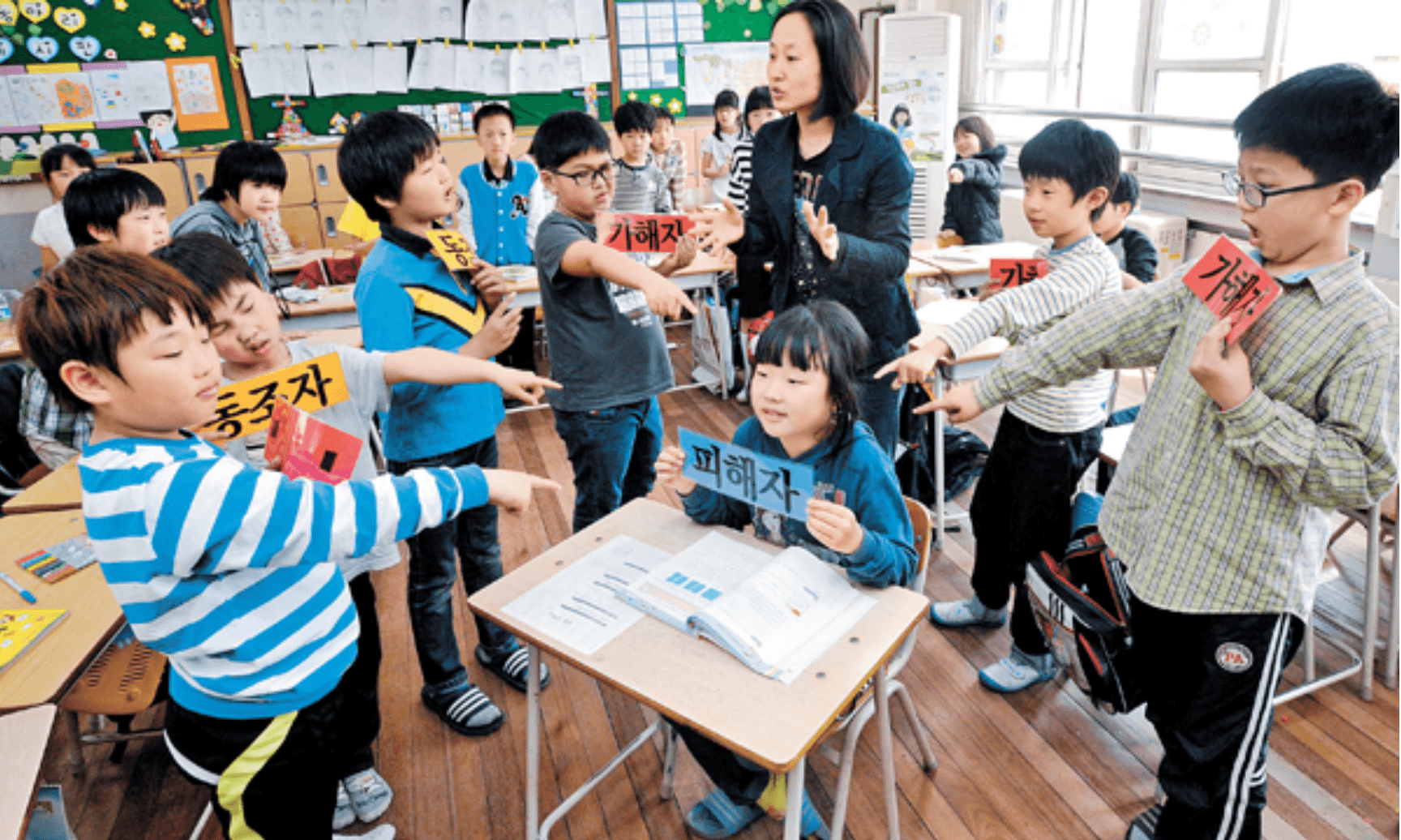
There is a pervasive attitude among teachers in South Korea that bullying is not a significant problem. Schools tend to silence bullying issues, minimize the occurrences of victimization, and transfer liability to parents. They argue that school bullying is something that parents should deal with (Lee, 2005). For victimized students, school transfers don’t help since bullies can continue to harass their victims via technology such as text messages, personal web pages, and emails, even after they move to a new school.
Teacher training has been studied as a method that may help increase teachers’ awareness and ability to intervene in bullying situation. Unfortunately, even these training sessions are limited in their effectiveness. They are often delivered via one-day work-shops with an emphasis on defining bullying and outlining the negative impact on students. These workshops may serve to increase awareness of bullying and victimization, but teachers are still left to figure out how to manage a bullying incident and often follow entrenched ways of addressing peer victimization (Yoon et al., 2011).
Teacher training programs may benefit from a more systematic approach that addresses important known variables while offering ongoing support to teachers as they face the challenges of dealing with bullying and victimization in their school (Yoon et al., 2011). Targeting teachers via intervention programs has proven to be the hardest in terms of finding success as there is usually a gap between the teacher-level and the school-level administration. Teachers can’t be expected to take on all the hard work of looking out for and stopping instances of bullying. Thus, perhaps implementing programs that target the school administration to work in coordination with teachers may be a more worthwhile endeavor.