Among South Korean studies, cyberbullying was generally categorized by behavior rather than the media used for it. It was generally examined in terms of cybermoyok/bibang (insults); cybermyungye-hweson (defamation); cyberstalking; cybersungpokryuk (sexting); gaeinjungbo-youchul (personal information drain); cybergangyo (coercion); and cyberttadolim (exclusion), cybergorophim (harassment), or cyber wang-ta.
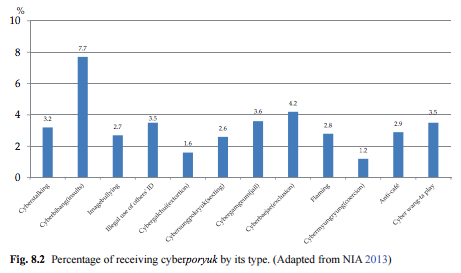
Hwang et al. (2013) investigated cyberpokryuk (cyberbullying) across 1500 elementary, middle, and high school pupils in different regions of South Korea. In this research, they provided the definition of each of the types of cyberpokryuk (cyber verbal violence, cyber defamation, cyber stalking, cyber sexual abuse, personal information drain) and asked each participants experience within the past year. The results indicated that 30.3% reported receiving at least one form of bullying, with the noticeably higher rate falling with middle and high schoolers at 34%, where elementary schoolers experienced bullying at a much better 7.4%.
Hwang et al., suggests that much of this discrepancy falls into the adolescent feeling the need to fit into societal norms, whereas children tend to be care free and not as worried about their outward appearance. As children develop into adolescence, there is an increased awareness of social interactions and have pressure to fit in with peer groups, especially those their age.

Collectivistic societies are, in general less attentive to each individuals mental state. In fact, in a survey conducted by Hwang, over 41.8% of the students surveyed felt that the school administration had the adequate resources or help for those who are cyberbullied. Since 2007, Korean schools have given general informational discussions about what to do when an individual is cyberbullied, but rarely offer much help aside from that. The collectivistic point of view, inhibits the school administrations from understanding that students sense an increased need for individual attention.