In all six of the Hofstede cultural dimensions, individualism versus collectivism has been one of the most widely examined cultural dimensions. Individualistic cultures promote independence by emphasizing uniqueness of the individual, while collectivistic cultures value cohesiveness between individuals and the interest of the group.
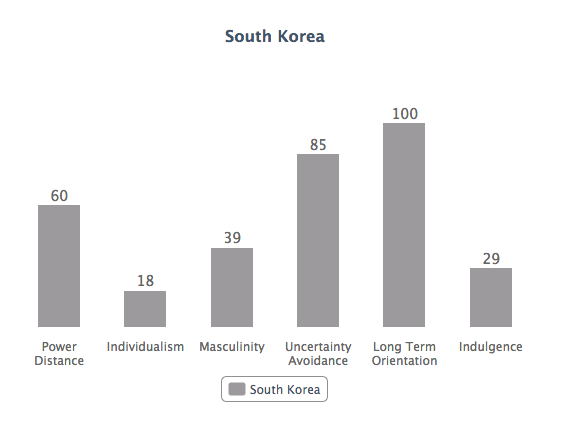
In studying bullying across cultures, differences in levels of individualism and collecitivism have explained cross-cultural differences effectively, especially in the South Korean context. South Korea is one of the most collectivistic countries in the world, with a score of 18 out of 100 on the Hofstede individualism dimension. The high level of collectivism affects the nature of bullying on a variety of aspects.

First of all, the reason for bullying occurances are deeply linked to collectivistic values. Although it is commonly assumed that the value of harmony and communal goals in collectivistic cultures can reduce incidents of bullying, in reality collecitivism encourages bullying “related to group conformity and cohesion” (Caravita and Cilessen, 2012). This is because collectivism values conformity to group norms. When an individual exhibited behaviors or beliefs that are not in line with group norms, she or he breaks the group’s status quo. The victim is therefore considered abnormal by the rest of the group and subsequently isolated by others based on his or her incoherence with the majority. Refusing to adhere to cultural norms in South Korea may be interpreted as an intention to cause group disharmony and disrupt ingroup solidarity. Only ingroup solidarity can be achieved through members’ willingness to sacrifice their own personal opinions and views for the sake of group harmony.
Furthermore, the type of bullying is also related to the high level of collectivism in South Korean culture.

Compared to individualistic cultures such as the US, South Korean bullies utilize more relational forms of aggression such as rumor spreading about the individual or their family or social isolation (Migliaccio and Raskauskas, 2016).
Since interpersonal relationship and agreement is extremely important for collectivism, bullying that causes harm to social relations and social status is more detrimental in a collectivistic culture than an individualistic one, where social harmony is less important. The prevalence of relational bullying also explains the high number of bullies and lower number of victims – it takes a group of people to exclude one or two single persons. Constrastingly, the physical bullying in most Western cultures involves only a couple of bullies who exerts their power on a number of victims.
In addition, the collectivistic mindset dictates not only the actions and attitudes of the bullies, but also that of the bystanders. Because the victim in relational aggresion is considered abnormal, those who stand with the victim are also inevitably associated with the victim and seen in the same negative light.
To avoid such negative perception from others, bystanders may:
- refrain from helping the victim
- turn into bullies by actively excluding the victim
It is not uncommon for an entire classroom to single out and collectively bully 2-4 individuals within the same class. Therefore, when bullying becomes a collective goal, the number of bullies in the group may rapidly increase. Support for the victim become arguably even more challenging than in a Western society, since those who defense the victim may be singled out too.