As adolescence is a critical period of cognitive and social development, living in a time of prolonged conflict can have a multitude of effects beyond the most commonly identifiable disorders. Post-traumatic Stress Disorder, or PTSD, often comes first to mind, but it is far from the only consequence. Furthermore, even those diagnosed with PTSD may not and often do not experience symptoms limited to a single scope.
According to the DSM-IV (Diagnostic and Statistical Manual of Mental Disorders), traumatized youth often feel more pessimistic about their future, and have a tendency to anticipate future trauma (Solomon & Lavi, 2005). Prolonged exposure to traumatic events can also affect brain development during adolescence, increasing the tendency for unnecessary risk-taking and coping poorly or unhealthily with stress (Rosshandler et al., 2016). In regards to the Israeli-Palestinian conflict, not only is there ethnic and religious conflict, there also exists a copious amount of violent physical conflict. Children often personally know people who have been killed or injured, may have had their daily routines interrupted due states of emergency, or in some cases, have even personally witnessed death or injury (Solomon & Lavi, 2005). As a result, lasting psychological damage may be sustained.
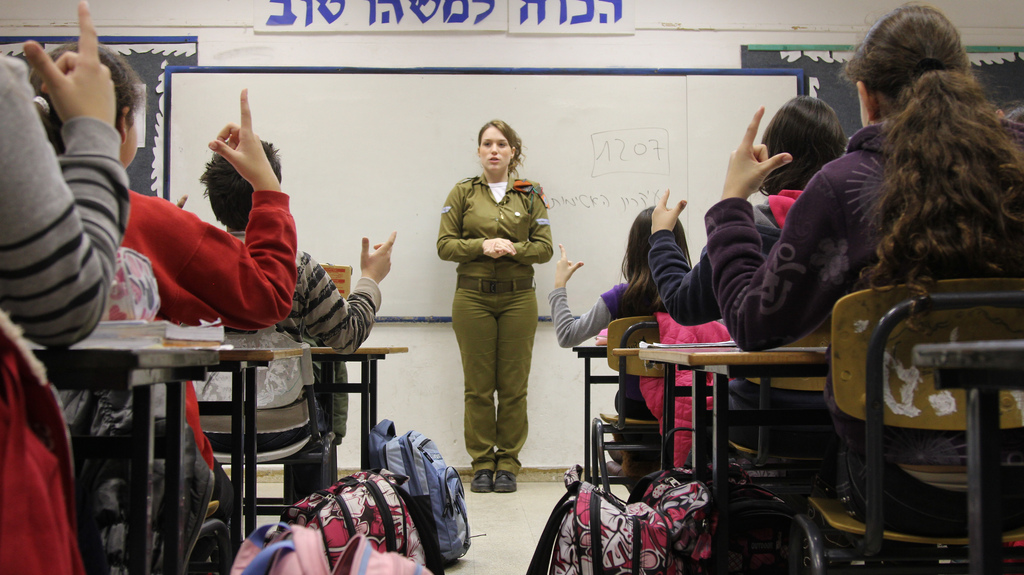
IDF Emergency Instructor
Source – https://goo.gl/172ONc
Functional Impairment
Functional Impairment is described in the DSM-IV-TR as “dysfunction in social and occupational spheres of life,” and further implies that “a mental disorder must be associated with either distress or disability” (Ustun & Kennedy, 2009). There are many domains of functional impairment, but there are a few specific domains in which Israeli youth have been particularly affected as a result of living in a place and time of political violence. Specifically, these domains include school functioning, social relationships, family relationships, and after-school activities.
One particular study of Israeli students utilizing a questionnaire with items from the Diagnostic Predictive Scale found that 15.9% of the students reported functional impairment in one domain, 7.6% in two domains, 2.1% in three domains, and 1.4% in all four domains (Pat-Horenczyk et al., 2009). School functioning impairment was reported the most frequently, followed by social, family relationships, and after-school activities. Students who had either full or partial PTSD reported greater functional impairment than students who didn’t have PTSD (81% vs. 41.5% in school functioning, 40.4% vs. 24.1% in family relationships, 52.2% vs. 27.5% in social relationships, and 40.9% vs. 21.6% in extra-curricular activities), but even the percentage of adolescents without PTSD experiencing some sort of functional impairment is incredibly concerning.
Functional impairment is particularly important to note in cases of youth as if such dysfunction continues in the long term, serious impairment could develop, resulting in a much greater amount of distress, anxiety, and inability to cope as a productive member of society. Failure to excel academically or socially may result in lower self-esteem, and struggling to maintain healthy relationships could result in a lack of social and familial support. All these factors are known to increase risk of mental illness, and for Israeli youth currently exposed to conflict are already more vulnerable.
Somatization
Somatization is a phenomenon that is identifiable as “a specific response style in which somatic symptoms are emphasized and psychological symptoms are concealed” (Ryder et al., 2011). In other words, the presence and identification of somatic symptoms can be indicative of psychological distress that is the true cause of the physical symptoms. In the same study as above, somatic complaints also analyzed in Israeli students exposed to political conflict. The results showed that 22.6% of the Israeli students reported one or two somatic symptoms, 5.2% reported three or four symptoms, and 0.6% reported five or six somatic. Difficulty sleeping was reported by 14.7% of the students, and overall, girls reported more symptoms than boys. Additionally, students already classified with full or partial PTSD experienced more somatic symptoms, though a significant number of other students also reported somatic symptoms.

Insomnia
Source – https://goo.gl/BNNdVV
These findings only further illustrate the amount of strain violent political conflict can inflict on the youth of a given culture. Some of these symptoms may appear to be temporary, but the effects may last much longer, affecting how an individual approaches life and their outlook on the world. In one study that examined the relationship between Israeli youth with symptoms of PTSD and future orientation, results showed that as the number of dangerous events experienced increased, the subjective perception of danger also increased. Additionally, those who displayed more symptoms of PTSD had a more negative future orientation in respect to work and social life (Solomon & Lavi, 2005).