Prevalence of PTSD
During the Second Lebanon War (2006) Hezbollah fired around 4,000 missiles into Northern Israel, causing 44 Jewish and Arab civilian mortalities, over 1,400 wounded, significant property damage, and thousands displaced or required to live in shelters (x).
This is only one example of the many kinds of trauma faced by people growing up in conflict heavy areas have to face. It is intuitive, then, that rates of PTSD, especially among school-age children, are quite high (for more info see PTSD page).
School-Based Interventions
More and more research is saying that schools should play a larger role in providing mental health services following traumatic events, and in identifying traumatized children (Chemtob, Nakashima, & Hamada, 2002). Often, in disaster or conflict situations, traditional mental health resources become overwhelmed. Utilizing teachers and school systems for mental health interventions is shown to be an effective way to reach a larger amount of children who may not otherwise receive care (Wolmer, et. al, 2013).
ERASE-Stress
One example of a School-Based Intervention in Israel is the Enhancing Resiliency Amongst Students Experiencing Stress, or ERASE-Stress (ES) Model. ERASE-Stress is a “school-based, teacher-mediated prevention program for reducing terror-related traumatic reactions in Israeli youth.” To test the effectiveness of this program, Gelkopf et. al. first brought ES to a male religious middle school in southern Israel. At baseline, 43.5% of seventh and eighth grade students at a school in Sderot were found to have a likely diagnosis of post-traumatic stress disorder (Berger et. al., 2012). They found that the intervention was successful and that the program may help students who are “suffering from terror-related post-traumatic symptoms and mitigate the negative effects of future traumatic experiences.” Here is a short explanation of the ERASE-Stress Curriculum:
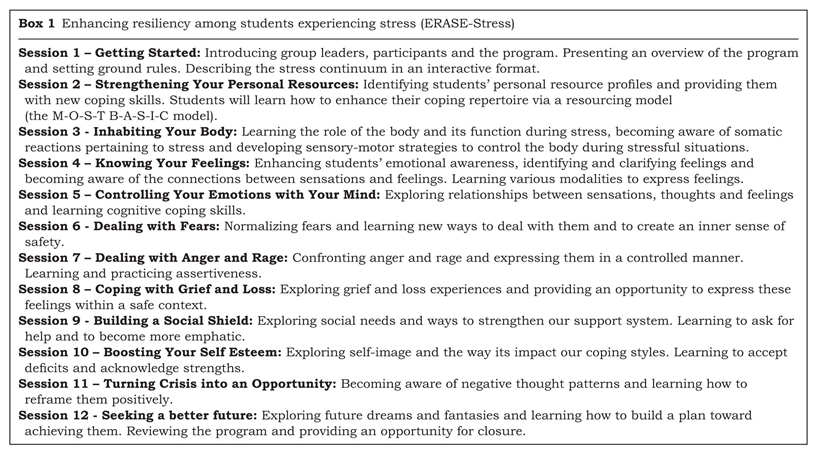
Image from Gelkopf, 2009
ERASE-Stress-Pro-Social (ESPS)
When Gelkopf et. al. ‘s 2009 intervention went well, they next decided to broaden the age group and incorporate some other elements in 2015. Hobfoll et al. (2007) suggested implementing a mental health intervention that in addition to addressing PTD (post-traumatic distress) and perception of threats, addresses negative attitudes toward outgroup members simultaneously to reduce the harmful effects of exposure to war and terror. Gelkopf et. al. took this to heart and created ESPS which attempts to decrease the effects of PTSD for students, and to decrease prejudice and acts of discrimination. They expanded the program from 12 to 16 weeks.
Two months after the program ended, students in the ESPS group showed a significant reduction on all measures as compared to the SS group. The results of the study showed a significant relationship between reduction in PTS symptoms and changes in attitudes toward Arabs. The findings stated that “the ESPS program might help reduce PTS as well as prejudicial attitudes and discriminatory tendencies toward minorities in children exposed to political violence” (Gelkopf et. al., 2015).