As conflict continues between Jewish Israelis and Palestinians, reports circulate regarding the groups’ shows of delight in violence against each other. In recent years, there have been accounts of Israeli citizens standing on furniture to watch and cheer as bombs drop on Palestinians living in nearby Gaza. Likewise, Palestinians have been reported to stand on rooftops to watch and celebrate rocket attacks against Israeli cities. These examples are displays of Schadenfreude, a German term for peoples’ enjoyment of others’ pain. Schadenfreude is a hallmark of a concept known as ingroup bias, which often induces a lack of empathy between conflict groups. By studying the psychology behind ingroup bias, researchers hope to develop effective forms of intervention to promote cross-cultural empathy and cooperation. Such forms of intervention will serve to be significant in facilitating long-lasting peace throughout the region.
Attribution: Wickey-nl
Source – https://en.wikipedia.org/wiki/File:Israel-Palestine_peace.svg
What is Ingroup Bias?
In psychology, an ingroup is a social group with which an individual identifies. An outgroup is a social group with which one does not identify. Outgroups may be further broken down into distant and conflict outgroups. A distant outgroup is a group with no direct and/or significant contact with one’s ingroup. A conflict outgroup is one that is involved in direct disputes and/or clashes with one’s ingroup.
These categories influence identity, so that people often strongly identify with their ingroup. Ingroup bias refers to the tendency to favor one’s own ingroup. This leads to preferential treatment of members of that ingroup, often at the expense of, and harm to, outgroup members. Ingroup bias is especially present in conflict situations, such as that between Israel and Palestine.
Effects on Intergroup Interactions
Multiple psychological studies have examined the impact of ingroup bias on the Israeli-Palestinian conflict. These studies particularly target youth, as there has been an increase in youth participation in the violence (Levy et al., 2016). The ultimate goal of these studies is to identify possible areas for intervention, with the hope of encouraging intergroup understanding and eventual social harmony. Below are examples of research that have explored the presence of ingroup bias in Israeli and Palestinian individuals.
Psychologists Levy et al. at Princeton University studied the neural and behavioral responses of Jewish Israeli and Palestinian adolescents to the pain of members in their respective ingroup versus that in members of the conflict outgroup. The adolescent subjects had been raised in climates of long-lasting violence. Levy et al. (2016) found that all groups displayed a neural marker for ingroup bias, and exhibited hostile behavior during interactions with outgroups members. The scientists also discovered that, as a result of violent conditions, the youth’s brains had shut down the automatic response to outgroup pain (Levy et al., 2016). In other words, the subjects had grown psychologically less sensitive to the suffering experienced by outgroup members. From this data, the scientists concluded that ingroup bias, stemming from exposure to prolonged conflict, strengthens cognitive mechanisms that block the brain’s evolutionary sensitivity to outgroup pain (Levy et al., 2016).
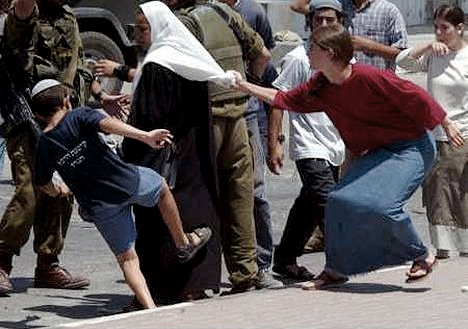
Jewish Israeli youth harassing a Palestinian woman in the street Source – https://www.flickr.com/photos/borisvienna/193331461
Levy et al.’s findings are especially relevant to conflict outgroups. A study by psychologists Bruneau et al. at the Massachusetts Institute of Technology explored the differences in groups’ perception of distant versus conflict outgroups. In this study, the distant outgroup was compromised of South American subjects. The conflict groups were composed of Jewish Israeli and Palestinian subjects. Bruneau et al. (2012) presented participants with scenarios in which a member of either the distant outgroup or the conflict outgroup experienced physical or emotional pain. The scientists found that the Israeli and Palestinian participants reported feeling significantly less compassion for members of the opposite conflict group than they did for members of the distant outgroup, for both scenarios of physical and emotional pain (Bruneau et al., 2012). The scientists concluded that neural activity differs in response to different types of outgroups. In particular, individuals are less sensitive to the experiences of conflict outgroup members than to those of others (Bruneau et al., 2012).
These studies illuminate strong ingroup biases in Israeli-Palestinian relations, particularly due to the fact that the cultures are conflict outgroups. Members’ decreased sensitivity to conflict outgroup pain and suffering exacerbates efforts for peace and reconciliation. Consequently, these studies help pinpoint the neurological bases and behavioral consequences of outgroup discrimination. In doing so, they contribute to the development of effective interventions that may decrease ingroup favoritism and intergroup hostility, leading to greater understanding between citizens of Israel and Palestine.