In times of turbulent political relations and violence, parents play a crucial role in mediating between the conflict a child experiences and the effect it may have on the child’s mental health and psychology. Through a meta-analysis of 32 studies, it was found that PTSD symptoms in parents are associated with an increased risk of PTSD symptoms in their children (Rosshandler et al., 2016). Therefore, it is crucial that we examine the effects parents have on children being raised in times of prolonged conflict. Are there specific things parents can do to minimize the distress of their children? Are there particular behaviors that may worsen a child’s trauma? Or, is any psychological distress caused by the Israeli-Palestinian conflict unaffected by the actions of parents?

Israel Defense Forces – Lieutenant General Benny Gantz and Family
Attribution: Israeli Defence Forces Spokesperson’s Unit
Source – https://commons.wikimedia.org/wiki/File:Flickr_-_Israel_Defense_Forces_-_Lieutenant_General_Benny_Gantz_and_Family.jpg
Parenting Styles
In order to further examine the possible affects of parenting on the psychology of Israeli children, we must first define the three global parenting styles, which refer to general patterns of parenting that have been observed across cultures (Matsumoto & Juang, 2013). They are as follows:
- Authoritarian – parents have expectations of unquestioned obedience and control over their children
- Authoritative – parents are firm, fair, and reasonable, with the goal of raising healthy, competent, and independent children
- Permissive – parents are warm and nurturing, but fail to provide discipline or establish firm rules
In classic psychology, it is generally well-accepted that children who feel accepted by their parents (or other guardian figures) tend to be more well-adjusted, increasing resilience to adversarial situations. While authoritative parenting is usually deemed the ideal parenting style for Western cultures, there is some debate as to its universality. For example, while the authoritative parenting style was found to be associated with higher academic achievement in Western cultures, authoritarian parenting was correlated with higher academic achievement in China (Slone et. al, 2011). Therefore, it is crucial to consider culture when evaluating the benefits of various parenting styles.
Effect of Parenting Styles in Israel
Slone et al. conducted a study with multiple experiments that examined the effect of parenting style on Israeli children, particularly in the context of moderating political violence. As Israel itself is composed of a collection of different ethnicities, cultures, and religions, the study was conducted separately on Israeli Arabs and Israeli Jews in order to account for possible discrepancies. Israeli Arabs constitute the largest minority in Israel at 20.3%, and with the influence of the Israeli-Palestinian conflict, it was plausible there’d be marked differences between these two demographics as result of the ethnic dynamics (Slone et al., 2011).
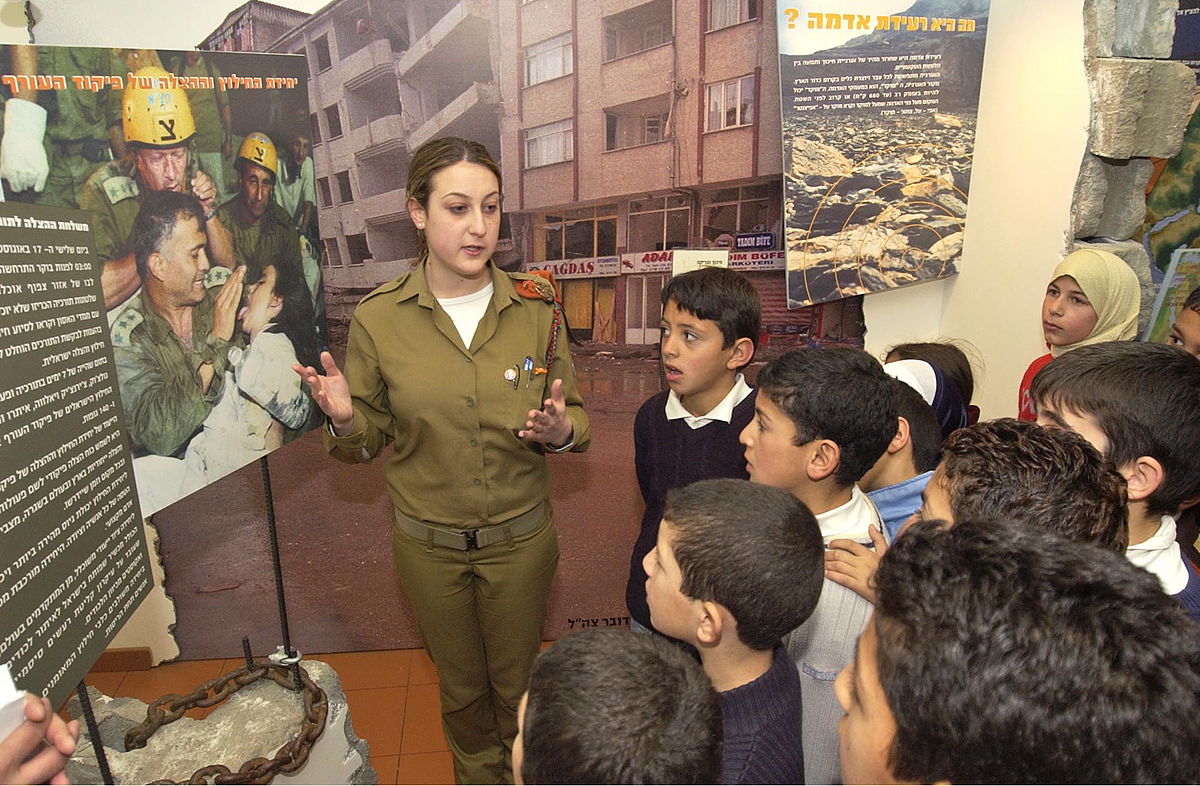
Soldier Explains Emergency Instructions to Arab-Israeli Children
Attribution: Israeli Defence Forces Spokesperson’s Unit
Source – https://commons.wikimedia.org/wiki/File:Flickr_-_Israel_Defense_Forces_-_Soldier_Explains_Emergency_Instructions_to_Arab-Israeli_Children.jpg
The results of the study were quite illuminating. First, and unsurprisingly, it was found that children exposed to more political conflict experienced more psychological distress. Additionally, the parenting style of the mother could moderate the distress experienced. Mothers who parented with an authoritative style were more likely to have children with lower psychological distress than mothers who parented with an authoritarian style, and this held true for both Jewish and Arab children. What was perhaps surprising, however, was mothers with a permissive style were equally harmful as authoritarian mothers for Jewish children, but for Arab children, permissive mothers were just as beneficial as authoritative mothers. A potential explanation for this phenomenon is that Arab children benefit more from a nurturing, warm environment due to additional pressures experienced from being a minority, though further study is required to confirm this fact.
Conversely, the impact of paternal parenting style was much less pronounced. In fact, there was no statistical significance that indicated paternal parenting style had any effect on Jewish children. In lower levels of exposure to political violence, the same held true for Arab families, but in higher levels of exposure, authoritarian parenting by fathers had a more negative impact than authoritative parenting. This can be seen as indicative of cultural differences that exist between Jewish Israelis and Arab Israelis, where traditionally, Arabic culture places more honor and authority in the father. However, the fact that the authoritarian parenting style was not beneficial in this case also suggests cultural values may be changing, or that in a state of prolonged conflict, warmth received from parents is a greater determining factor.
Mental Health of Parents
In turbulent and uncertain times, it is not only children who are affected. Parents themselves may struggle to cope, and as a result, their own mental health may influence their children. As stated above, it has been found that parents who display symptoms of PTSD are associated with an increased risk of the same symptoms in their children. The trauma of the parents may be caused by political violence and conflict, but may also be further worsened by being unprepared to deal with the trauma of their own children, which starts a vicious cycle (Rosshandler et al., 2016). Even if PTSD is not a factor, parents may experience feelings of guilt and sadness, which may develop into more serious conditions.