The Israeli-Palestinian is an ongoing global issue with no clear end in sight. Cross-cutting factors such as ethnicity, religion, and nationality all increase the complexity of a potential solution. However, by promoting intercultural competence between the two states, there is hope for a gradual de-escalation of violence and eventual peace for both sides of the conflict.
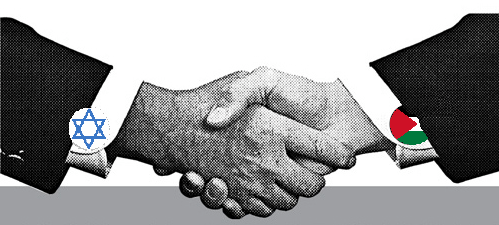
Source – https://commons.wikimedia.org/wiki/File:Israel_Palesting_Peace_Treaty_Handshake.PNG
Specific challenges in promoting intercultural competence between Israel and Palestine include:
- Ethnocentrism
- Ingroup bias
- Collective identity
- Delegitimization and mistrust
- Clashing religious values – Israelis are almost entirely Jewish, while Palestinians are mostly Muslim. In both groups, religion has a predominant role in daily life, cultural customs, and political interests.
- Clashing ethnic values – Israel is made up of a majority Jewish population. Palestine, on the other hand, is majority Arab. Arabs are generally a more traditional and collectivist culture, which impacts a large range of beliefs and world views (Slone et al., 2011).
- Clashing political interests – Many Jewish Israeli citizens support Zionism, or the formation of a Jewish state. For the Palestinians, however, the land of Israel was stolen from them and still belongs to them. Clashing political interests lie at the core of the conflict, further exacerbating tension and hopes for reconciliation.
The following are some of our recommendations to increase intercultural competence between Israel and Palestine (Mollov et al., 1999):
- Encourage a deeper understanding between the two groups – Developing deeper understandings of each other’s cultures will help to eliminate unfounded assumptions and break down inaccurate stereotypes. It will also serve to humanize members of the opposite group in ingroup members’ eyes, thereby decreasing groups’ ‘othering’ of each other that is used to justify discrimination and violence.
- Encourage social interactions – Findings from previous studies demonstrate the potential for people-to-people contact and dialogue to help break political ‘stalemates.’ Promoting interpersonal interactions between the groups will initiate a grassroots effort to facilitate cross-cultural understanding and rebuild relations.
- Target youth – Multiple studies, including many examined on the website, have shown that youth lie at the core of the achieving a long-lasting resolution to the conflict. Through interventions such as anxiety prevention and treatment programs, cross-cultural education programs, and positive media focusing on the other culture, efforts to target youth may serve to alter psychological biases against the opposite conflict group.
- Support peace talks – Direct negotiations between Israel and Palestine will work towards de-escalating the violence and ending the conflict. By supporting international leaders’ participation in peace talks, one contributes to the initiation of the peace process.